Understand their cognitive strengths
Wadmore Cognitive ProfilePerformance across eight cognitive areas, with a detailed report showing patterns of relative strength.
From$199Available now
Get started →Educational assessment, with TLC.
A clearer picture, and a way forward.
We help you make sense of their strengths, the challenges and the practical next steps for home and school.
Free 15-minute conversation. No obligation to book. For school-aged children, Adelaide Hills and online.
Thorough assessment.A careful look at the evidence.
Listening first.Time to understand your child and your family.
Clear next steps.Practical next steps for home and school.
A good place to start
You don’t need to know which assessment to ask for. Start with what you’re noticing.
Reading, writing, maths or simply keeping up: we start with your observations, your child’s experience and the school’s perspective. Together, we can work out whether assessment would add something useful.
Explore learning assessmentsA little of everything? We can talk it through.
How we can help
Each service has its own colour, so you can follow it through this site. Two are available now; academic assessments are coming soon, so join the interest list to hear first. Every fee is fixed, published and includes GST.
Performance across eight cognitive areas, with a detailed report showing patterns of relative strength.
Make sense of existing findings and turn recommendations into achievable actions for home and school.
Standardised assessment that identifies patterns of achievement and where targeted support may help.
Academic achievement and cognitive strengths, each measured with the right tool and considered side by side, with one plan for home and school.
Educational assessment and guidance. We assess learning and achievement and help you act on the results. We don’t provide diagnosis; if your question needs one, we’ll help you find the right professional.
Learn the difference →From a question to a next step
Meet Sam, an illustrative example of how we bring a child’s strengths and challenges into the same picture.
Sam shares detailed ideas aloud. His written answers are short. Both observations matter.
We explore his writing skills, how he approaches a task and what he says he finds difficult.
One possibility: talk through an idea before writing it down, and agree a manageable starting point with his teacher.
Sam is fictional. Each child’s circumstances guide the recommendations.
Explore the sample reportThe person behind TLC
Former Head of Global Assessment, Janison (ICAS) · Former Principal Consultant, SA Department for Education · Master of Education · Founder of The Learning Clinic and Wadmore
Careful assessment.
A classroom perspective.
Someone to talk it through with.
The next question is what it means for your child’s everyday learning. Matt brings experience across classrooms, school leadership and educational assessment to that conversation.
The Learning Clinic brings careful assessment together with an understanding of what happens in real classrooms, helping families and educators make informed decisions about each child’s learning.
As Head of Global Assessment at Janison, Matt led the international assessment business that includes ICAS, used in more than 40 countries. Before that he was a Principal Consultant with the South Australian Department for Education and led Kangaroo Island Community Education to Regional School of the Year three years running. He is also the founder of Wadmore, an adaptive cognitive assessment platform.
Understanding leads to action
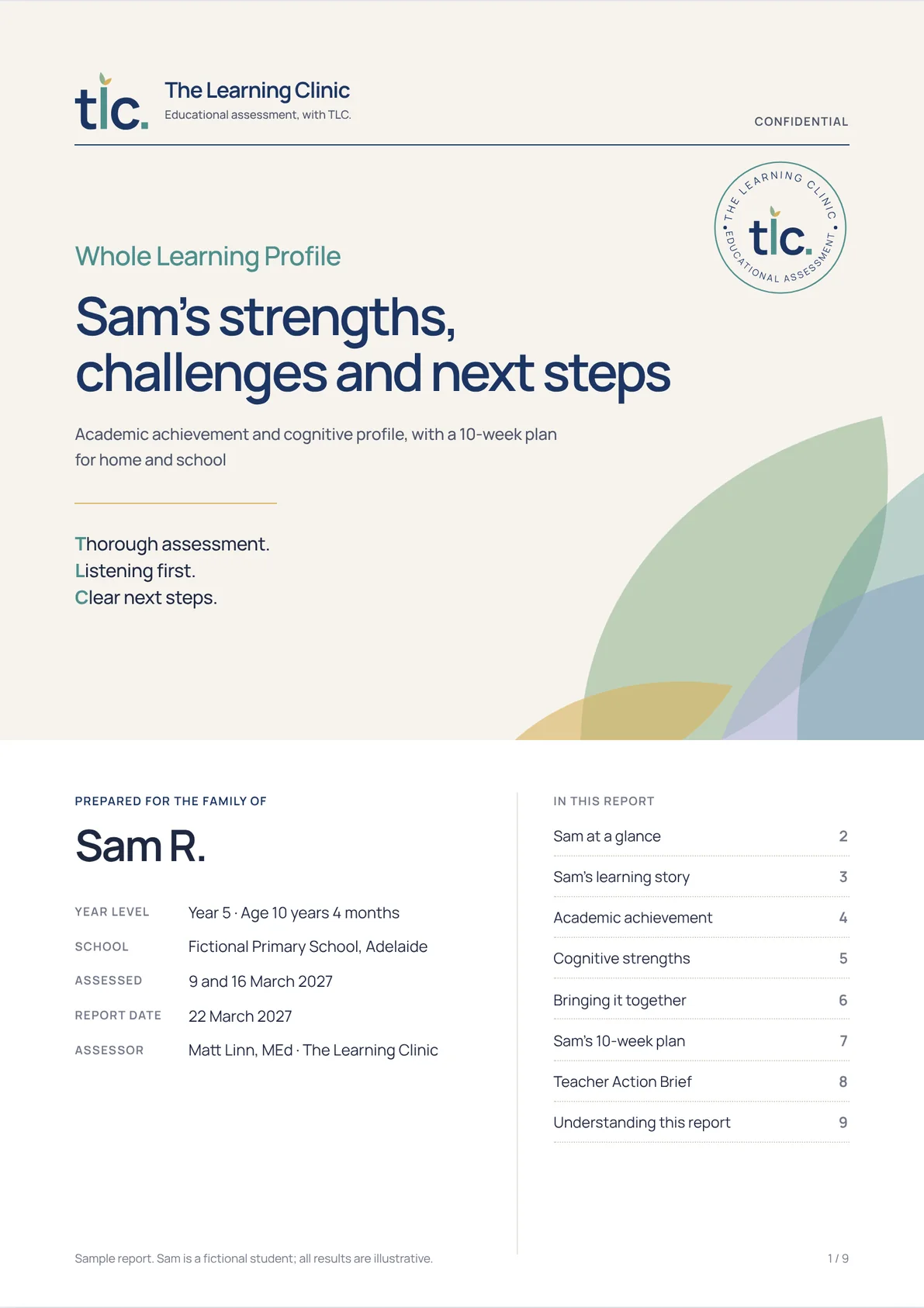
See how assessment findings can become clear explanations, priorities for home and guidance for school. Sam is a fictional student; his report shows the format of our Whole Learning Profile.
Clear information. Useful recommendations. A way forward.
An assessment should do more than describe how a child performed on a particular day. It should help you understand what the results mean, why they matter and what to do next. Switch between typical report language and the way we explain the same findings.
Phonological processing weaknesses impacting decoding fluency for polysyllabic words.
Sam finds longer words harder to read accurately, so his reading slows down.
Standard score of 84 (14th percentile), falling within the below average range.
On this task, about 86 in every 100 children his age scored higher. With targeted practice, this can improve.
Relative weakness in working memory capacity affecting written output.
Sam’s spoken ideas are rich, but his written answers are short. Planning support helps him get more onto the page.
Recommend explicit, systematic, multisensory intervention.
For example, ten minutes a day of structured practice with sounds and letter patterns, at home and at school.
What to expect
Children deserve to feel comfortable, respected and encouraged. We take time to listen, explain what will happen, make room for breaks and recognise each child’s individual needs.
How to explain it to your child
“We’re going to do some learning activities together to understand what feels easy, what feels tricky and what helps.”
We send simple, age-appropriate wording to help you explain the session, and let you know if there’s anything to bring. There’s nothing to study for.
We start with a chat, explain each activity and build in breaks. Most children find the tasks interesting.
We talk with you first, in plain language, then help you share what’s useful with your child and school in a positive, strengths-first way.
Because understanding a child begins with listening to them.
Questions
No. The Learning Clinic provides educational assessment and guidance: measuring academic achievement, profiling cognitive strengths and turning results into practical action. We don’t diagnose conditions such as a specific learning disorder or ADHD; that requires a registered psychologist or medical practitioner. If your question needs a diagnosis, we’ll tell you at the free call and help you find the right professional, and we can help you use their report afterwards.
Keep it simple and positive: “We’re going to do some learning activities together to understand what feels easy, what feels tricky and what helps.” There's nothing to study for. We'll send age-appropriate wording and what to expect on the day before your session.
Not necessarily. Schools make these decisions based on a range of evidence, including teacher observations and how your child is going in class; professional reports are often helpful but not always required. Our reports can provide supporting information for those conversations, but buying an assessment isn’t a requirement for asking. If a report is intended for an application, tell us at enquiry so we can check what the school or SACE Board will need.
We work with school-aged children. Wadmore profiles and the Whole Learning Profile suit ages 8 to 18. Report to Plan suits school-age children with an existing report. Age ranges for academic assessments depend on the instrument and are confirmed at the suitability call.
Consultations and Report to Plan can be online or in person. Academic assessments are conducted in person. The Wadmore profile is completed online at home.
Yes. It's a 15-minute conversation to understand your questions and recommend the right next step, with no obligation to book.
Free 15-minute call
Whatever has brought you here, you don’t have to work out the next step on your own. Start with a free 15-minute conversation. We’ll listen, talk through what you’d like to understand and help you choose the right next step, even if that’s another professional. You can also join the interest list for services opening soon.